Your skin is home to a busy, mostly invisible community of bacteria, yeasts and other microorganisms. In recent years that community, the skin microbiome, has moved from research labs onto product labels, with words like "biome-friendly", "prebiotic" and "postbiotic" now common on moisturisers and cleansers. The idea is appealing. The science is real but still young, so it helps to separate what is reasonably understood from what is still being worked out.
What the skin microbiome is
The skin microbiome is the mix of microorganisms living on the skin's surface and in hair follicles. It isn't the same everywhere. Oily areas such as the sides of the nose, damp areas such as the underarms and dry areas such as the forearms each tend to host different communities.
Researchers broadly agree on a few points:
- Most of these microorganisms are harmless, and many seem to play a useful part in keeping skin balanced.
- The microbiome works together with the skin barrier, the outer layer of cells and lipids that holds water in and keeps irritants out.
- It changes with age, climate, hygiene habits, sweat, medication and the products we use.
- Some skin conditions go along with shifts in the microbial balance, but it is often unclear whether the shift causes the problem or follows it.
What the labels usually mean
Microbiome skincare tends to fall into a few loose groups. None of these terms has one fixed regulatory definition, so they are best read as descriptions rather than guarantees.
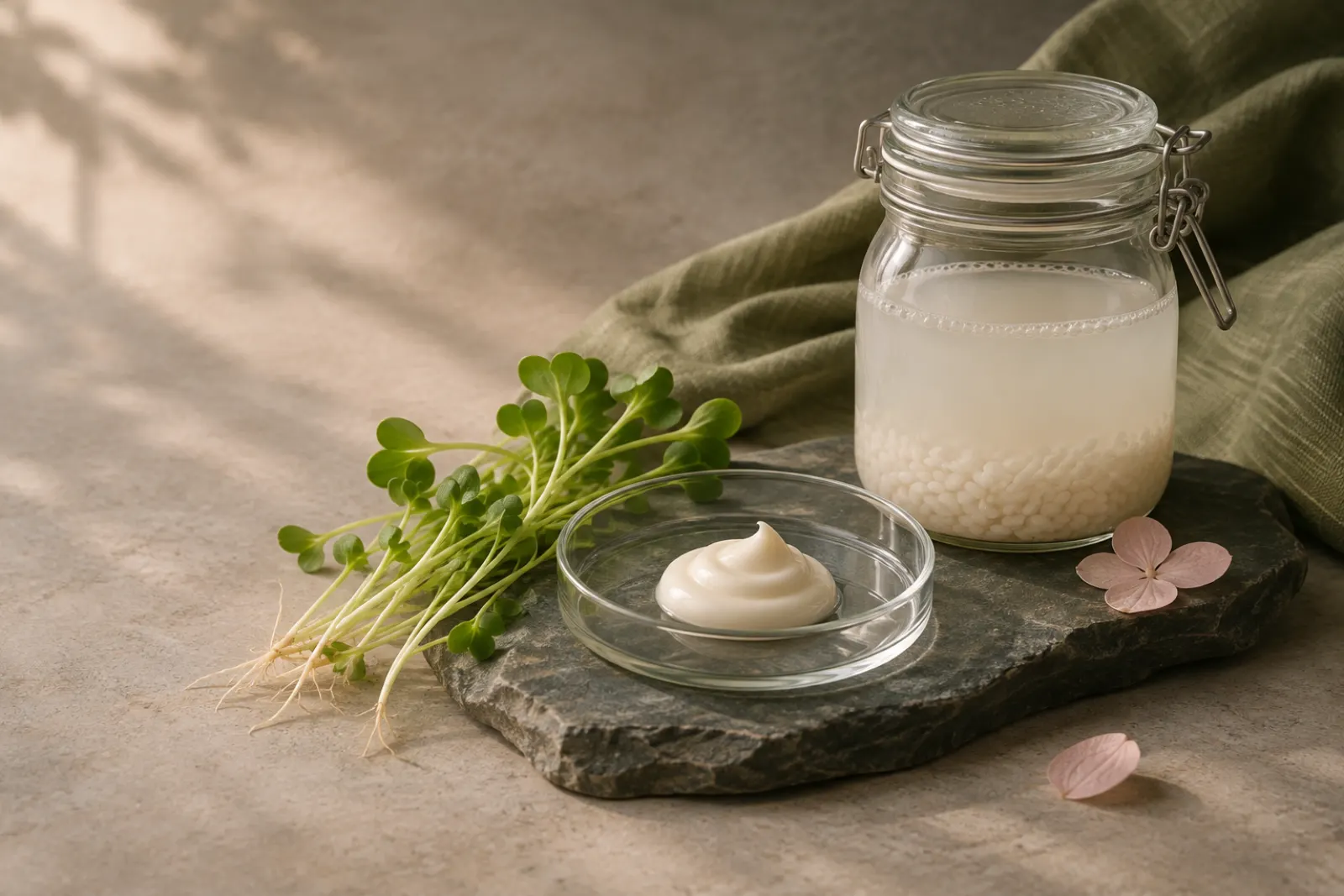
- Prebiotics: ingredients, often sugars or plant-derived fibres, meant to feed the microorganisms already on your skin.
- Probiotics: products said to contain live microorganisms. Keeping anything alive in a cosmetic formula is technically tricky, so many products in this group actually use inactivated forms instead.
- Postbiotics and ferments: substances made by microorganisms, or lysates and ferment filtrates of them.
- "Microbiome-friendly" formulas: products designed to be gentle, with mild cleansing agents and a skin-appropriate pH, so they don't upset the existing balance.
The last group is probably the easiest to make sense of. It is less about adding something new and more about not stripping or irritating the skin.
The limits of the evidence
This is where some caution helps. The field is growing, but several gaps remain:
- Much of the research is early-stage, carried out in the lab or with small groups of people.
- A "healthy" microbiome has no agreed definition. It differs from person to person and from one part of the body to another.
- Showing that a product changes the microbiome is not the same as showing that the change leads to visibly better skin.
- Results from one formula can't simply be applied to another, even if the ingredient names look alike.
So an interesting ingredient may well be worth trying, but bold claims on a label run ahead of what is firmly established. This is general information, not medical advice. If you have persistent redness, breakouts, itching or flaking, a pharmacist, doctor or dermatologist is the right person to ask.
Supporting your skin's balance in Hong Kong
You don't need specialist products to look after the conditions your microbiome likes. Much of it comes down to sensible barrier care:
- Cleanse gently. Over-washing, harsh foaming cleansers and very hot water can strip the skin. After a sweaty MTR commute or a hike, a mild cleanser is usually all you need.
- Moisturise steadily. Air-conditioned offices dry skin out even when the air outside is humid. Look for familiar barrier-supporting ingredients such as glycerin, ceramides and panthenol.
- Go easy with actives. Using several exfoliating acids or retinoids at once can leave skin irritated. Introduce them slowly. Our guide to actives without irritation explains how.
- Wear sunscreen daily. Strong UV stresses the skin barrier all year round, not only in summer.
- Don't keep switching. Changing products every few days makes it hard to tell what is helping, and it can unsettle sensitive skin.
Next steps
If a microbiome-focused moisturiser appeals to you, treat it like any other new product: patch test first, add one thing at a time, and judge it by how your skin feels over a few weeks rather than by the label. Browse gentle options on our moisturisers shelf, learn to read an ingredient list, or start from the basics with how to build a skincare routine. You can find more explainers in the Journal.